
Wayne County Court Record Requests
Start with four things. Know the court, the case number, the case type, and the exact product you want. The public register of actions is the chronological record of court events. It is not the same as a filed order. Nor is it a full case file, a certified copy, a typed transcript, or county digital audio. For viewing public information, the Judicial Branch’s court-records search policy allows JUSTICE, an authorized remote provider, or a courthouse terminal. For a Wayne County case, remote JUSTICE works well. It helps identify the case and its public register. The courthouse terminal suits a local search, and the local clerk can handle requests too. County Court holds traffic, ordinance, misdemeanor, small claims, probate, and other county matters. District Court keeps its own civil, felony, domestic-relations, and other district records. Sending a request to the wrong clerk just because the parties or county match will slow the docket search down. So match the clerk to the court that actually holds the case file.
Wayne County Court
Ashley Siebrandt, clerk magistrate
510 Pearl Street, Suite B
Wayne, NE 68787
402-375-1622
Wayne District Court
Diane Pieper, Clerk of District Court
510 Pearl Street, Suite 6
Wayne, NE 68787
402-375-2260
Note: Wayne's local offices do not publish a complete ordinary-record email or dropbox process. Call before mailing documents or payment.
Wayne Court Record Request Details
A focused request gives the clerk something concrete. Give the court, Wayne County, and the case number. Add the case type, a public caption if needed, a document title or date, and whether you want inspection or a copy. Certified or uncertified? Full file or selected pages? Add your delivery preference and any deadline. "The record" can mean several things, so asking for the register when you only need the event history often beats requesting every page in the file. For a formal request beyond routine access, spell out the custodian, the court, the date range, the record component, your preferred format, and whether inspection or copies are sought. The state’s Public Records Act, §84-712 generally provides for inspection and copying. An exception may apply. Judicial policy also allows a written request to be forwarded to the State Court Administrator. Even so, a formal request is no substitute for a quick JUSTICE docket search.
Kinds of Court Records
Let the product drive the request. A register answers what was filed or recorded over time. A filed document supplies the underlying pleading, order, judgment, or exhibit where public and available. Clerk certification gives a copy its authentication. A transcript is typed proceedings. County digital audio is a recording. A criminal-history report is a separate product, and no public docket search creates one.
| Request | What it is | Wayne route |
|---|---|---|
| Register of actions | Chronological case events. | JUSTICE, courthouse terminal, or clerk. |
| Filed document | Pleading, motion, order, judgment, or other file item. | Available public image or a request for the named document. |
| Uncertified copy | Reproduction without clerk authentication. | County or District Clerk. |
| Certified copy | Clerk-authenticated copy with the needed seal. | Relevant clerk with certification identified. |
| Transcript or audio | Typed proceeding or county hearing recording. | Court reporter or clerk process. |
Choose the product first. That habit helps the Wayne clerk route the request and quote the right process without confusing a public register view with an official copy.
Wayne Court Record Products
Nebraska's district records-maintenance rule describes a court record system. Its components include the register of actions, trial docket, judge notes, financial record, general index, judgment index, and case file. That rule supports a simple habit: name the component you want. Financial entries do not replace an order. An index result does not certify that a case file is complete or public.
County Court requests benefit from the same distinction. The County Court clerk is the local gateway for county-court registers, copies, traffic questions, the public computer, and local file access. The District Clerk handles the district register, judgment or trial indexes, case-file copies, and court-reporter routing. The state's access policy governs statewide electronic access. The local clerk identifies the particular file and the current process.
Court Records: What They Contain
A public case result usually opens with the basics. Expect a case number, caption, party roles, court, type, and status. The register may list dates and filing titles. It may also show summons or service events, hearings, motions, orders, judgments, payments, and disposition entries. An available image is an underlying item in the court docket. Its presence does not make every other document public. And a certified copy carries the clerk’s authentication. A plain printout from a case lookup cannot match it.
| Case number | The unique court identifier used to retrieve and cross-check the file. |
|---|---|
| Caption and party roles | The public case style and the parties’ procedural roles. |
| Register of actions | Chronological filings, hearings, rulings, and other recorded events. |
| Case file | Pleadings, motions, orders, judgments, exhibits, and supporting material where maintained. |
| Financial record | Receipts and disbursements, distinct from an order or judgment. |
| Judgment index | Judgment debtor, creditor, and case number in the clerk’s records system. |
Public availability varies by component. A case number or register entry may still leave a particular filing or certification requiring a clerk request.
Access Rules for Court Records
Article 8 on public electronic court records identifies the public paths. It covers party indexes and case summaries. Public registers with available images are included. Calendars and summaries of judgments, orders, and decrees are covered too. The article also recognizes protected, sealed, statutory-confidential, and criminal-history limits. Local counters and terminals follow those same limits. A courthouse computer does not open restricted material.
The Judicial Branch's Article 8 sets out these access rules in its official material.
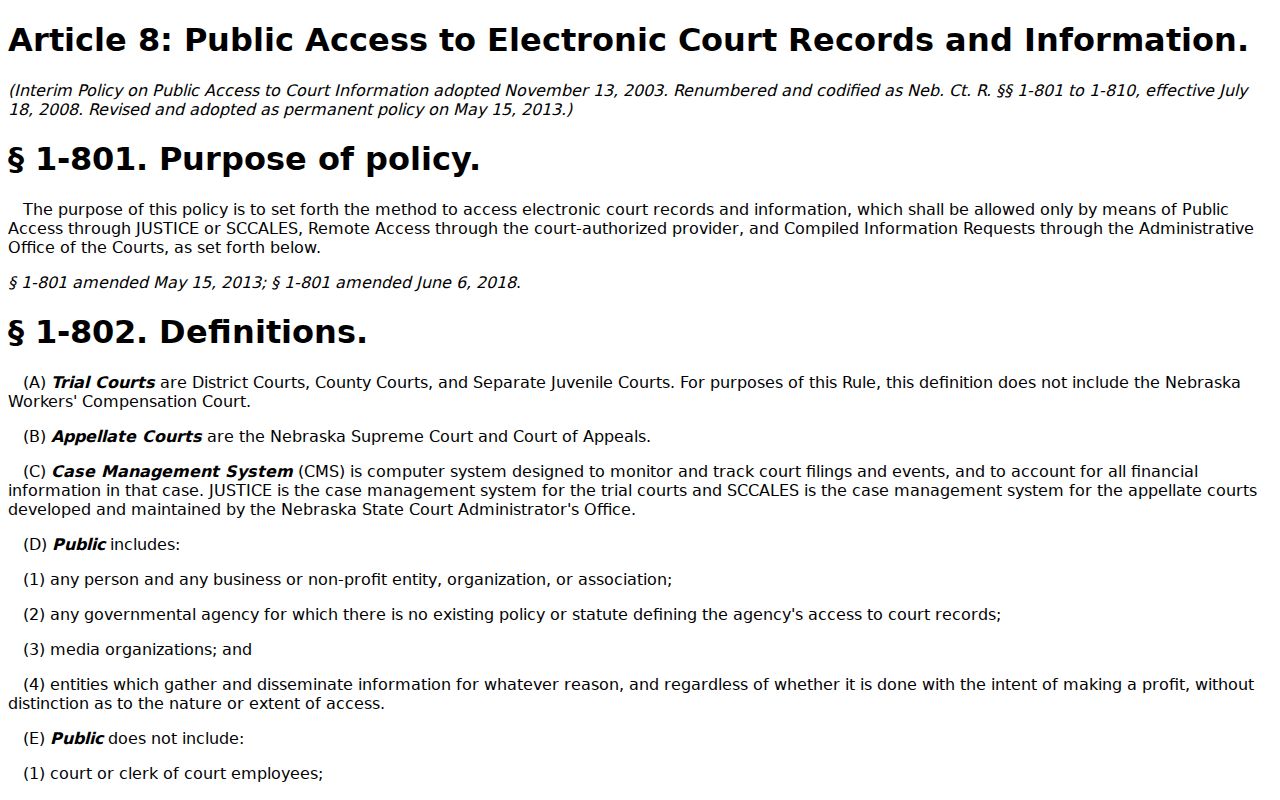
This is why public indexes and registers can be available while particular documents stay redacted, sealed, or unavailable for remote display.
Access limit: Nebraska’s Article 8 rule, Public Records Act §84-712, juvenile confidentiality statute §43-2,108, protected-record rule §2-210, and criminal redaction rule §6-1524 all affect what a Wayne court custodian may disclose.
Copy Fees and Certification
Copies in Wayne County run on a simple fee structure. The CC 3:30 copy invoice shows a $0.25 charge per page. It adds $1 for a seal. That seal line is the listed form charge. It is not a published flat certification fee for every purpose. Totals can shift with page count, delivery method, and what you order, so confirm the clerk's current math before mailing payment. Also keep these charges apart from filing fees, court costs, remote search fees, and balances owed on a case.
| Item | Fee or status | Request note |
|---|---|---|
| Paper or file copy | $0.25 per page | Shown on CC 3:30; confirm the current Wayne total. |
| Seal | $1 per seal | Shown on CC 3:30 for a certified-copy request. |
| Typed transcript | Estimate paid in advance | Amount depends on the proceeding; rush service costs extra. |
| County digital audio | $10 first hearing on CD; $5 each additional hearing or CD | Confirm delivery calculation and access before ordering. |
Name the document, your certification choice, and how you want delivery. A general fee schedule alone will not give you a reliable total.
Wayne Court Record Copy Form
The CC 3:30 form gathers everything a clerk needs to price a copy request. It covers case type, county, case number, caption, the date copies are made, certified or uncertified, requester and billing details, copy count, page count, seals, and the total due. Wayne County's copy FAQ tells callers to state which documents they need. It also asks whether certification is required. It flags that some files live on microfilm. So call before you visit or mail anything. The county offers no standard online checkout, no set turnaround, no electronic-delivery promise, and no dropbox route for ordinary records. A clerk will quote the fee and the request method for your actual file.
Wayne Court Record Sealed Files
A broad public request will not unlock juvenile, adoption, sealed, or confidential material. For your own sealed record, the Judicial Branch provides DC 1:12. The form asks for the court, county, case number, case style, the scope you want, who receives the release, delivery, and who pays. Send it to the clerk in the county where the case was filed. DC 1:12 is not a public-request form. It also sets no single statewide charge. The clerk can quote page, certification, and mailing costs for an authorized release. Do not attempt to defeat a redaction or sealed status with a name variation, a public terminal, or a generic request.
Wayne Court Record Microfilm
"Not visible online" does not mean a Wayne County record is gone. It may sit on microfilm. It may predate online images. It may live in a permanent register with its own retrieval process, or be protected. State retention rules keep district registers in JUSTICE while handling older indexes, microfilm, and case files differently. Wayne's call-ahead advice matters most when you already know the document, date, or page range. Start with JUSTICE or the public terminal. Pull the court, case number, caption, and register entry there. Hand those details to the clerk. Ask whether the file exists as paper, microfilm, or an electronic image. This way the staff never has to guess what you mean.
Wayne Court Record Transcript Audio
For a typed transcript, the route is CC 1:14. Go through the court reporter or clerk. The form captures the court, county, case number or name, hearing date and time, judge, full or partial coverage, exhibits, requester details, and attorney bar number. A party or counsel can order directly. A nonparty needs the trial judge's approval. The reporter produces an estimate, and payment comes before any work starts. On appeal, follow the appellate transcript instructions instead of treating this routine request as the appeal path. County digital audio runs on Appendix 6, one case per form. It wants hearing-level details, the presiding judge, courtroom, delivery, and requester information. Audio is restricted whenever the hearing was, and it is expressly not the official record. Ask the clerk which product you truly need. Decide on audio only after weighing it against a certified copy or transcript.
Wayne Court Record Policy
Nebraska's court-records search policy lays out the public terminals, written requests, copies, and certified-copy rules. It applies statewide, with the Wayne court offices carrying it out day to day. Reach for it when a request must be formal. For a routine county or district file question, just ask the clerk. Ask the clerk who holds that record. The policy page itself puts the clerk counter, terminal, and written-request routes into one access framework.
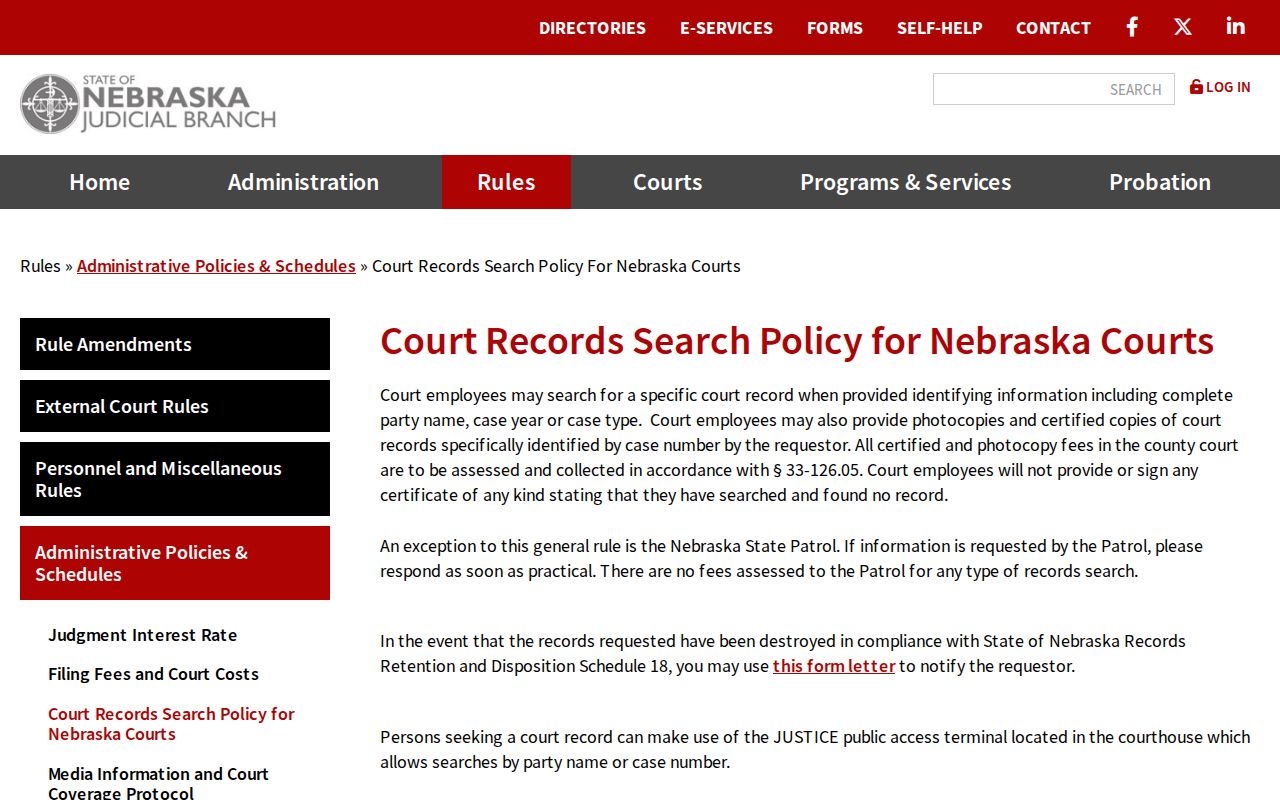
Need a case number before ordering copies? A focused Wayne County docket search can supply the court and register details. It complements the clerk's copy process rather than replacing it.
Wayne Court Record Request Check
Gather your details before you call. Write down the court, Wayne County, case number and type, the caption only as needed, and the document title or event date. Also list selected pages or the full file, certification choice, and inspection or delivery preference. Note any court date, filing deadline, or appeal deadline that affects timing. A request that names the product from the start gets routed faster. If something is withheld, ask why. Not found, not retained, sealed, restricted, and not indexed for public remote access. Those are five different outcomes. The clerk can point to the route that exists. But no request label can turn protected material public.